Before the Spaghetti Western: How the Screen Western Found Its Story
Screen Western history comes into focus through landmark films, from The Great Train Robbery to Stagecoach, High Noon, and the Italian Westerns that reshaped the genre.
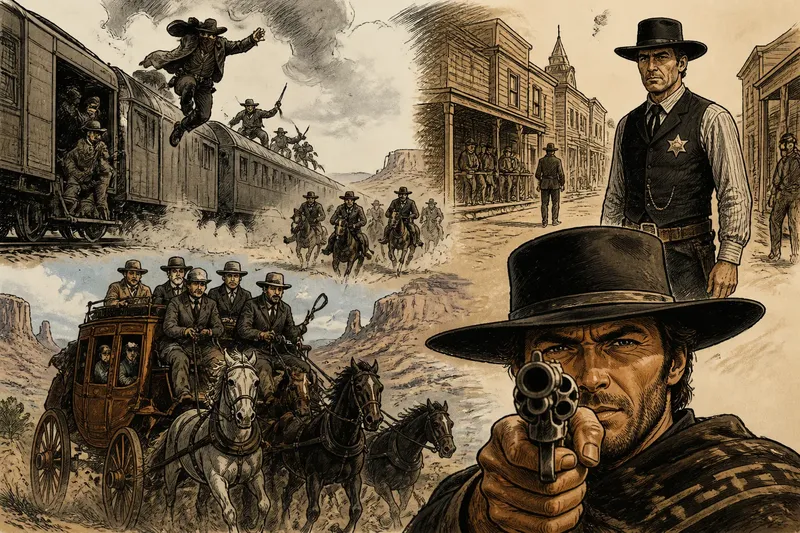
A bandit leaps onto a moving train, and a gunman turns toward the camera. In The Great Train Robbery (1903), that closing gesture is a jolt as much as a plot beat. The film offers a vivid starting point for screen Western history: early filmmakers made the frontier legible through motion, danger, and spectacle before later works gave those conventions more room to develop.
The route from a short chase film to the Italian Westerns of the 1960s was not a straight line. Landmark films show how the genre’s storytelling changed: The Great Train Robbery stages pursuit, Stagecoach (1939) brings a group of travelers together under pressure, and High Noon (1952) makes a lawman’s public duty a crisis that unfolds in near real time. Each retains recognizable Western materials while using them differently.
What did early Westerns put on screen?
Edwin S. Porter’s The Great Train Robbery, made for the Edison Manufacturing Company, is a useful early landmark. Its short scenes show a train holdup, pursuit, and confrontation. The film’s now-famous close-up of a bandit aiming a gun at the audience could be placed at the beginning or end of screenings, a reminder that early cinema often presented striking attractions as well as continuous stories.
The film does not need elaborate dialogue to make its action readable. A train, a robbery, a pursuing posse, and a final confrontation provide clear visual cues. The camera makes movement and space do much of the storytelling: the audience can see who is escaping and who is closing in.
That model drew on popular stories and stage traditions, but cinema gave it a particular tool: the ability to cut between places and actions. The Western’s early appeal was not simply open country. It was the visible puzzle of movement—who gets away, who follows, and what happens when they meet.
How did the feature Western build a larger story?
By the late 1930s, a Western could carry its action through a longer ensemble story. John Ford’s Stagecoach follows a group of passengers traveling through dangerous territory. The journey provides a simple physical thread, but the drama also comes from watching strangers share a confined space and respond to danger together.
That structure differs from the compact chase of The Great Train Robbery. The earlier film makes pursuit itself the event; Stagecoach uses a journey to keep several characters in contact. The landscape still shapes the action, but the vehicle and its passengers create a moving social world. A Western could now make the audience watch not only a rider’s skill, but how people behave when they cannot easily leave one another.
This is a change in storytelling scale, not a clean replacement of one form by another. Later films kept chases, rescues, and confrontations. What expanded was the space for relationships and consequences around them.
Why does High Noon feel different?
Fred Zinnemann’s High Noon (1952) concentrates its story around Marshal Will Kane, who learns that a returning outlaw is coming to town. The approaching train gives the plot a clear deadline, while Kane’s attempts to find help make the townspeople’s responses part of the drama. The question is no longer only whether a gunman can win a confrontation; the film also asks what public duty means when a community hesitates to share its risks.
The film’s clock and repeated appeals give its tension a distinctive shape. Instead of treating the showdown as an isolated burst of action, it makes the waiting and the refusals matter. The result is a Western whose central suspense depends on social choices as much as gunplay.
That does not mean the genre suddenly became morally complicated in the 1950s. It means High Noon offers a clear example of a Western using familiar action to foreground a sustained dispute about responsibility and law.
What changes in the Italian Westerns?
Italian Westerns, often called spaghetti Westerns, emerged as a recognizable cycle in the 1960s. Sergio Leone’s A Fistful of Dollars (1964) reworks the lone-stranger story, while The Good, the Bad and the Ugly (1966) places its characters amid the American Civil War. These films borrow familiar Western situations—rival gunmen, uneasy alliances, standoffs—but give them a distinct style through stretched silences, close-ups, striking music, and heightened violence.
Leone’s films did not arrive in a genre-free landscape. They could play with the audience’s knowledge of the lone gunfighter and the showdown because earlier Westerns had made those figures and scenes familiar. The change is less a rejection than a rearrangement: the old ingredients remain, but their pacing, tone, and moral certainty shift.
For instance, a showdown can be staged not as the clean restoration of order but as a contest among self-interested characters. That difference matters more than the presence of a wide-brimmed hat or a dusty street. Genre history becomes easier to follow when you compare what a familiar scene is asked to mean.
How can you compare these Western milestones?
Say you are watching The Great Train Robbery, Stagecoach, and High Noon in that order. Start with the visible action in Porter’s film: a robbery and pursuit make the basic conflict clear. In Ford’s film, follow the travelers through the journey and notice how shared danger changes the story’s focus from one pursuer to a group. In Zinnemann’s film, track Kane’s appeals for help and the townspeople’s choices before the confrontation. The resulting comparison is specific: pursuit organizes the first film, a group journey organizes the second, and a deadline with civic stakes organizes the third. This is an invented viewing plan, not a claim about a real viewer’s experience.
A simple way to keep the distinctions clear is to treat each film like a different kind of clock: one runs on pursuit, another on a journey, and another on a deadline. For any Western, note these concrete features and decide what they tell you:
- Opening event: If the story begins with a robbery or pursuit, then track how movement creates suspense; if it begins with a journey or a threat to a town, then identify the larger situation that organizes the plot.
- Story’s main engine: If characters are chasing or escaping, then follow who controls the distance; if they are traveling together, then watch how their relationships shape the route; if a deadline drives events, then note what must happen before it arrives.
- Source of authority: If one lawman or gunfighter makes the decisions, then ask what limits that person’s power; if a group or institution is involved, then observe who is heard and who is excluded.
- Role of the landscape: If open country separates pursuer from target, then consider how distance delays contact; if a town or enclosed vehicle concentrates characters, then watch how proximity changes their choices.
- Meaning of the showdown: If violence settles the immediate threat, then check whether the story also resolves the underlying conflict; if the dispute remains, then note what the ending leaves unsettled.
- Ending’s emphasis: If the protagonist leaves, then ask what that departure implies about belonging; if the protagonist stays, then identify what has changed in the community or its rules.
Which questions help place a Western in its history?
What is the earliest landmark Western film?
The Great Train Robbery (1903), directed by Edwin S. Porter, is a landmark of early American narrative cinema and an influential early Western. It combines a train holdup, pursuit, and confrontation in a compact story.
How does Stagecoach differ from an early chase film?
Stagecoach (1939) builds its story around a group traveling through danger, giving character relationships more room than a brief pursuit allows. The journey links its episodes while keeping the landscape central to the action.
What makes High Noon a different kind of Western?
High Noon (1952) organizes suspense around a deadline and a lawman’s unsuccessful efforts to find help. Its attention to waiting and civic responsibility gives the approaching showdown a social dimension.
Why are Leone’s films called spaghetti Westerns?
The term refers to Westerns made by Italian filmmakers, including Sergio Leone, during the genre’s international expansion. His films use familiar Western figures and situations but distinguish themselves through their pacing, sound, and heightened style.
What does this history reveal about the genre?
Screen Western history is easiest to see in particular films rather than in a vague march from simple stories to complex ones. Porter’s film makes pursuit and visual surprise its center; Ford’s Stagecoach turns a journey into an ensemble drama; Zinnemann’s High Noon lets a deadline expose a community’s choices; Leone’s Westerns reshape the lone-gunfighter story through a different cinematic style.
When you watch the next Western, start with its organizing device: a chase, a journey, a clock, or a standoff. Then ask what that device makes visible—and what it leaves in the background. That small distinction can reveal how the film inherits the genre’s history while making its own version of the West.