Saddle, Train or Stagecoach: How Westerns Frame the Journey
Compare horseback, rail and stagecoach travel in Westerns to see how each frames the landscape, limits the view and shapes a journey on screen.
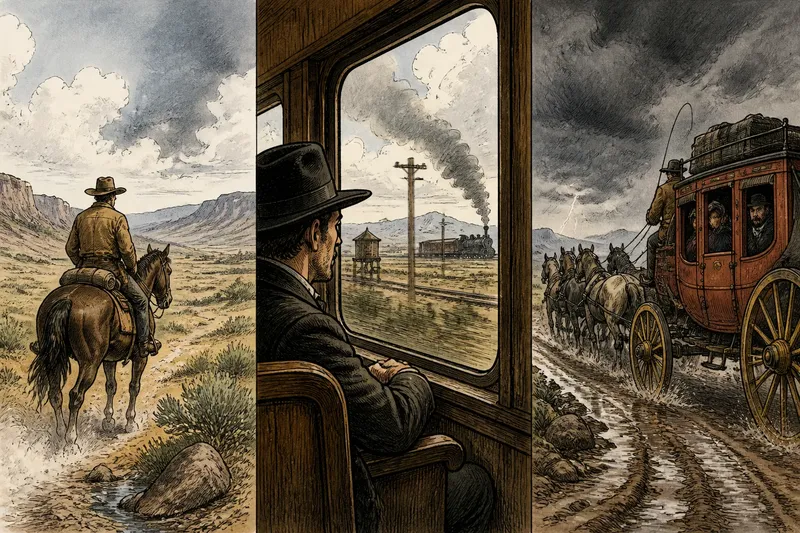
A rider crosses open country with a cloud of dust behind him; a train cuts through the same landscape with a whistle and a schedule. Horseback, train and stagecoach scenes in Westerns do more than move characters toward a destination: each gives the camera a distinct way to frame the land and the people passing through it.
Think of the three modes as different picture frames. The saddle leaves the country open around one figure, the train creates windows within a moving structure, and the stagecoach encloses a small group against the road outside. That visual distinction can shape a scene without turning every journey into a lesson about character or plot.
How does a horseback journey frame the landscape?
A rider’s journey puts the body directly against the terrain. A creek, ridge or shifting sky occupies the same space as the horse and rider, and the camera can hold them together in a wide view. A close shot of reins or a glance toward a distant cabin then brings the audience back to the rider’s immediate surroundings.
This approach gives filmmakers room to vary scale. A wide shot can make a rider seem small against a plain; a lower angle can let a ridge dominate the composition; a lingering view of hoofprints can connect movement with the ground. The landscape feels close because the route is visible as a succession of physical features rather than a distant panorama.
Horseback travel also makes changes in direction easy to show. A rider can leave a trail, pause at a stream or turn toward a rise, and the camera can follow without needing to establish a large vehicle or fixed route. The result is a flexible visual vocabulary, especially in scenes where the audience needs to see exactly how a character relates to the country around them.
What does a train window do to a Western landscape?
A train divides the scene into interior and exterior. Through a window, the land appears in passing sections, while the carriage gives the camera a contained place to watch passengers. This contrast can make a landscape feel like a view being observed rather than ground being crossed on foot or horseback.
The train’s motion supplies a steady visual rhythm. Telegraph poles, stations and stretches of open land pass in succession, while the camera can remain with a seated passenger or shift attention among people sharing the car. A character looking out at the country may be framed by the window, turning the view itself into part of the composition.
Rail scenes also provide a recognizable visual contrast between the machine and the land. The straight track, smoke and metal surfaces stand apart from uneven terrain and open sky. A filmmaker can emphasize that contrast with a wide exterior shot, then move inside to show the landscape reduced to a framed view.
Why does a stagecoach feel visually different?
A stagecoach places the camera near a small group while keeping the road and surrounding country in view. The coach’s cramped interior can make faces and gestures prominent; an exterior shot restores the larger setting, with wheels, dust and team occupying the route.
Because the coach has a visible connection to the road, its surroundings can remain present even when the passengers are inside. A bump, a stop or a turn can redirect attention from a conversation to the terrain outside. The scene can move between close human detail and a broader view without leaving the journey behind.
That balance distinguishes the stagecoach from both a lone rider and a train car. It offers a small interior group, but its route remains legible as a road through the landscape. Directors can use the coach’s doorway or window as a frame within the frame, keeping passengers and country in visual conversation.
Which visual choices suit each Western travel mode?
How can a horseback scene show distance?
Set the rider against a clear landmark, such as a ridge or isolated tree, then let the camera retain enough of the landscape to show the route. A later angle on the same landmark can make the change in position visible without relying on dialogue.
How can a train scene make a window matter?
Compose a passenger and the view beyond the glass in the same shot, or cut between the passenger’s face and the passing country. The window then acts as both a literal boundary and a visual frame.
How can a stagecoach scene balance faces and scenery?
Move between close views of passengers and exterior shots that show the coach on the road. Keeping the vehicle recognizable in both kinds of shot helps the audience understand where the people are in relation to the landscape.
Can a Western mix these visual approaches?
Yes, if the transition is clear on screen. A cut from a train window to a rider crossing the same open country can change the audience’s view from framed observation to direct exposure to the landscape.
How can a scene make the travel mode visible?
Begin with one concrete visual question: should the audience see the land as open ground, a passing view, or a road that contains a close-knit group? Then choose shots and props that reinforce that frame. A saddle, reins and hoofprints help establish the rider’s contact with terrain; a window, track and carriage interior identify rail travel; a coach door, wheel and road keep a stagecoach scene grounded in its route.
Say a filmmaker is staging an invented scene in which two wary passengers share a stagecoach while a storm gathers beyond the road. The starting point is a cramped interior and a darkening view through the window. The director first frames both passengers together, then cuts to the coach wheels on a muddy stretch, and finally returns to one passenger watching the other. The expected result is a clear visual exchange between confined faces and exposed road; if the storm becomes difficult to read from inside, an exterior shot can establish the weather before returning to the passengers.
For Western screen culture, the useful distinction is not which vehicle tells the “right” kind of story, but what each lets the audience see. The saddle leaves the rider and terrain in the same open frame, the train turns landscape into a passing view, and the stagecoach links close faces to a visible road. Choose the mode whose framing makes the scene’s setting easiest to read, and the journey will feel specific before anyone explains it.