Why the Western Main Street Shapes a Scene
Learn how a Western main street uses entrances, open ground, and buildings to shape movement and suspense, making a town’s geography part of the story.
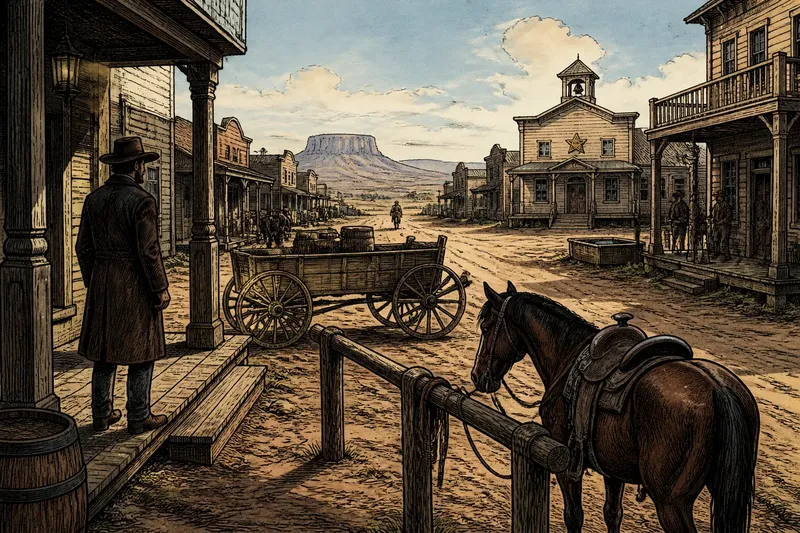
A saloon door swings open, and a horse shifts its weight at the hitching rail. In a Western main street scene, the space between buildings can shape a moment before anyone speaks. A long view down the road may make an arrival feel inevitable; a narrow passage beside a wagon can turn a simple crossing into a choice.
How does a Western main street guide movement?
The main street gives characters routes with different degrees of exposure. Someone can step out of a hotel doorway and cross the open road, or stay close to a storefront and move under the shelter of its porch. The route itself helps the viewer understand whether a character is approaching directly, taking a detour, or holding back.
Directors can make that geography clear with a wide shot, then tighten the view as a character reaches a destination. A hitching rail, wagon, or water trough can interrupt a path and slow the crossing. These details work like furniture in a room: they make the space usable and shape where people can go.
Consider the route before assigning it a meaning. A character walking toward the sheriff’s office may be seeking help, but the scene has to establish that intention through action or context. The street makes the movement legible; it does not tell us what the character thinks.
What makes an arrival feel tense?
A long stretch of open ground gives a character time to be seen approaching. The camera can hold on the distant figure, cut to a saloon doorway, then return to the person still crossing the road. That delay lets suspense build through space and timing rather than dialogue.
Buildings also frame what can be seen. A doorway can conceal someone until they step outside; a gap between facades can keep a distant road visible. If the scene returns to a familiar view, the audience may begin to anticipate movement along that route.
Sound can reinforce the effect. Hoofbeats, a swinging sign, or the creak of a porch board may be heard before the source is clearly shown. The street becomes a place where an arrival can register in stages: first as sound, then as movement, and finally as a person in the frame.
How do buildings shape the town’s geography?
Saloon, hotel, general store, and sheriff’s office are recognizable Western locations, but their placement matters as much as their names. A scene can show a character leaving one doorway and heading toward another, making the town’s layout part of the action. The audience does not need a map if the film keeps routes visually consistent.
Porches create a useful transition between indoors and the road. A character can remain under the roof while looking out, then step into the open when the scene calls for a change. Windows, awnings, hitching rails, and alleys similarly mark edges and entrances without requiring an explanation.
Set design may compress or stretch the street to suit the scene. What matters for the viewer is whether the buildings and routes remain understandable within the film’s visual logic. A clear sense of where the road leads helps an arrival, escape, or pursuit feel grounded.
What should you look for in a Western main street?
Why does a wide street make an approach feel exposed?
With few obstacles, a character crossing the road remains visible for longer. The open ground can make the approach feel deliberate and give the scene time to build anticipation.
How do porches and doorways affect movement?
They mark the boundary between shelter and open ground. A character who steps from a porch into the road changes position in a way the camera can show clearly.
Why do Westerns reuse the same street view?
A recurring view helps the audience recognize routes and landmarks. Once the geography is familiar, a changed path or unexpected arrival can be easier to follow.
What can block a character’s route?
A wagon, trough, hitching rail, or narrow gap between buildings can interrupt a direct path. Notice whether the character stops, goes around the obstacle, or chooses another route; each action changes how the movement unfolds.
How can you read a street scene without overinterpreting it?
Track concrete choices: where a character enters, which route they take, what blocks the way, and where the scene cuts. Then separate what the image shows from what you infer. A person standing beside a wagon is an observable detail; the reason they chose that spot may remain unclear.
Say a fictional scene opens with a traveler outside the hotel, a wagon partly blocking the road, and the sheriff’s office visible across the street. The traveler walks around the wagon, pauses at the curb, and then continues to the office. The observable result is a delayed, visible approach; whether the traveler feels nervous or simply cautious is a separate interpretation unless the scene supplies more evidence.
When you search for Western main street scenes, pay attention to how the route, obstacles, and buildings organize the action. A clear street layout lets a film make movement easy to follow while leaving the characters’ motives for dialogue and performance to establish.